
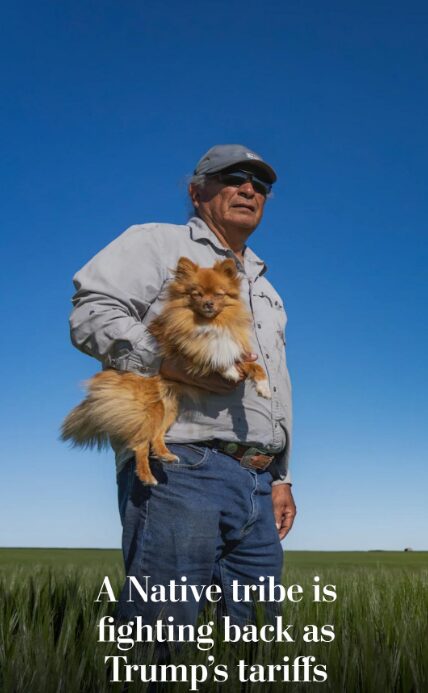
BLACKFEET INDIAN RESERVATION, Montana
The July day dawned warm and dry, like it was designed for haying, but by midafternoon, farmer Wayne Smith had yet to cut a single blade of grass.
His baler had broken that morning, and as soon as he fixed it, his tractor refused to run. He knew what would make the machine go again — a pointed metal fitting the size of a half-smoked cigar — but he also knew that he didn’t have one and, because of President Donald Trump, the part would be hard to find.
Now he was sitting in his pickup truck, tapping on the wheel and thinking about how an $18 piece of metal was holding up work on a field of untouched hay worth $5,200. He was waiting for a call from his longtime ranching partner and fellow Blackfeet Nation member, Buzz Momberg, who had gone to check a local store. The phone vibrated and Smith answered before it could ring. “Hey, Buzz,” Smith said, hoping he had good news. He didn’t.
“S—,” Smith said. He tapped the wheel again.
He knew one store that would definitely have the fitting: Rocky Mountain Equipment, a dealership 80 miles north across the Canadian border. Unlike American stores, which prioritized John Deere, Canadian suppliers tended to stock Case IH parts. Rocky Mountain had been his go-to for nearly 30 years.
That changed in early 2025, when Trump imposed 25 percent tariffs on steel and aluminum from Canada, among a slew of other items, arguing the fees were necessary to combat the flow of illegal drugs across the northern border and to rectify trade imbalances. A Supreme Court ruling later struck down some tariffs against Canada and Mexico, but left in place taxes on the two metals. Last week, less than two months after Smith’s tractor broke, the president announced additional 50 percent tariffs on a wide variety of Canadian goods after trade talks broke down. In response, the prime minister ordered “dollar for dollar” levies on hundreds of American products, including steel, aluminum and agricultural equipment.
Smith, 72, couldn’t keep track of what was happening 2,000 miles away in Washington. He just knew that parts bought in Canada now could cost hundreds of dollars more. And his reliable Canadian customers stopped buying his grain because of the tariffs their country had imposed in retaliation. He had no cushion in his budget to absorb the twin blows.
He was one of many Blackfeet finding it harder to pay their mortgages, buy groceries and refill on gas amid the escalating tariffs standoff, in a community where a third of residents already live below the poverty line. Most of the tribe’s roughly 10,000 members, whose reservation spans 1.5 million acres across northwest Montana, own or work for businesses dependent on cross-border trade and tourism.
Jonathan St. Goddard, a fellow rancher, had to pay hundreds extra for a tractor wheel he’d bought in Canada. Jackie and Steve Conway, a couple who co-managed an RV and tent campsite, had seen a significant drop in reservations. And David and Rhonda Mountain Chief had considered shuttering their cab service ferrying hikers, campers and climbers into Glacier National Park after international visitors and bookings disappeared.
A year earlier, Smith, St. Goddard, the Conways and the Mountain Chiefs had sued the Trump administration, alleging the tariffs violated their property rights under the constitution and ignored their autonomy as a tribe, long guaranteed under a treaty almost as old as America. Their case was one of a surge of lawsuits filed by private citizens alleging Trump’s aggressive reshaping of government and the private sector has undermined their core civil liberties, according to a Washington Post analysis of thousands of court records.
The tribe’s lawsuit had asked the court to immediately halt the tariffs’ enforcement, but a trio of judges dismissed the case over a jurisdictional issue. The decision left Smith and the other members of the Blackfeet tribe facing a second summer of Trump’s tariffs, with consequences for their lives and livelihoods that were deepening with each passing month.
Asked about the tribe’s litigation and concerns, White House spokesman Kush Desai wrote in an emailed statement that “the reality is that decades of lopsided trade arrangements have undermined workers, farmers, and business across America.” He added that Trump is “committed to the prosperity and wellbeing of every American, and that includes Native American communities.”
The president and his lawsuit were far from Wayne Smith’s mind as he wondered how to fix his tractor. From the seat of his truck, Smith could just see the farm of his neighbor. Randy Haynes, he knew, ran a lot of Case IH machinery and might have a spare part, so he dialed.
“You awake?” Smith said. “Don’t lie, you’re probably napping. … Listen, do you have a fitting? It needs that little pointed end on it.”
Haynes said he probably had something that would work, stored away somewhere in his barn.
“Looking at it, I’d know if it’ll work or not,” Smith said. “I’ll just head that way, and we’ll see if we have something.”
He tapped the wheel. “If not … I don’t know.” A day earlier, David Mountain Chief was sitting in his sagging white van, waiting for the Texas couple he’d arranged to collect from the Granite Park trailhead an hour’s drive into Glacier National Park.
They were late. The parking lot where he was stopped — tucked along a scenic curve of Going-to-the-Sun Road — should have been crammed with cars on day like this. But many spots were empty.
So were most lookout sites Mountain Chief, 67, could see farther down the mountain. Beside him, his wife, Rhonda, 65, held a spiral planner open in her lap, and that was half empty, too. She used the black book to track client bookings.
He looked away from the blank white squares consuming June, July and August.
Trump’s fault, he thought.
“Are you here to pick up some hikers?” A woman staggered over, introducing herself as Cynthia Ludgate. She had thought the loop was 11 miles, she said, but her watch showed 15. Her husband had fallen behind. She’d jogged the last mile, worried the Mountain Chiefs wouldn’t wait.
“Our motto is we have your back,” Rhonda Mountain Chief said, swallowing Ludgate in a hug. “We wouldn’t have your back if we left you.”
“I guess I’m just used to big-city people,” Ludgate said, brushing away tears as her husband, Scott, stumbled into view. Dark sweat outlined the .44 Magnum revolver strapped to his chest. It was his last defense against grizzly bears, he explained as the Ludgates climbed into the van. She was a schoolteacher. He was an Army veteran.
“Me, too,” David Mountain Chief said, mentioning that he also served in Operations Desert Shield and Desert Storm. As the van began winding out of the mountains, the couples talked about other things they had in common, like long marriages built on mutual tolerance. And that’s how the president entered the conversation.
“I’m highly conservative, very Trump,” Cynthia Ludgate said. She slumped one shoulder toward her husband: “But he will quibble on that.”
“I voted for him all three times,” her husband said. “Nonetheless, do I agree with everything that that man is doing?” He shrugged.
Rhonda Mountain Chief looked from the gun to the silver cross Cynthia wore. Not likely to be the most receptive audience, she guessed, but she decided to tell them about her lawsuit against the president anyway. “You can’t run a business on uncertainty,” she said, as the van wheezed to the top of Logan Pass.
It didn’t matter to Rhonda that a handful of judges she’d never met had dismissed her lawsuit over what she saw as a technicality. To her, the claim was as real now as when the suit was filed. And every set of passengers offered another chance to make her case.
Ten years before, she told the Ludgates now, she and her husband had founded the Mountain Chief Cab Company to drive tourists between trailheads, hotels and the East Glacier train station. She asked clients to sign a guidebook with their home countries, because she liked reading over the names of places she’d never been: Maui. Buenos Aires. Denmark. Scotland. The Philippines.The cab service was the Mountain Chiefs’ main income, Rhonda explained, averting her eyes as the van passed another sparsely filled lookout spot. What they earned between May and September — $50,000, in a good year — had to cover food and clothes for their four children and care for Rhonda’s sick brother, as well as helping other members of their large family pay for things like school clothes, braces and doctors’ visits. It was more than a business, she said. The couple used the long drives to teach visitors Blackfeet history, telling stories entwined with Glacier’s lakes and mountains, where the tribe has lived for thousands of years, archaeologists believe, and which the Blackfeet call the “backbone of the world.”
But Trump’s tariffs, and the subsequent drop in international tourism, threatened to undo everything, Rhonda told the Texans. In the first year of Trump’s second presidency, foreign travel to America fell 6 percent, with Canadian trips declining by 25 percent. Tourism to Glacier — which the federal government once calculated as worth 5,700 jobs and $550 million to the local economy — dipped by almost 100,000 visits, after more than a decade of mostly growth. “I don’t got no foreigners, I only have Germans out this
year,” she said. “Where’s all the other people?”
Rounding a curve sharp as an elbow, the van, which had surpassed 156,000 miles in 13 years of service, gave an unhappy clink. David Mountain Chief wondered again about the $56,000 private loan the Mountain Chiefs had applied for two months ago so they could buy a new vehicle. If the van gave out before the money came, he didn’t know how they’d keep the cab service going.
In the back seat, Scott Ludgate was nodding. He said again that he didn’t like everything Trump did. “I mean, to tear down part of the White House. Why don’t you focus on something that’s actually more important?”
“It’s just sad,” Rhonda said. “I don’t see how a man that has no heart can be leading our country.”
She looked at Cynthia, who looked out the window, pressing her lips together.
The silence stretched to six seconds.
She’s a good woman, Rhonda told herself. And she’s on vacation.
“Hopefully we’ll see a bear,” Rhonda said, changing the subject. “Did you guys see a grizz or anything up there?”
The Mountain Chiefs delivered the Ludgates to their campsite and parted with a hug, but without mentioning Trump or the lawsuit again.
A half-mile away at the Heart of Glacier campground, perched at the park’s edge, the Conways were realizing their summer was already a disappointment.
Huddled by the computer in their front office, they were going over the numbers. Bookings were down for the second season in a row.
Last year, the first summer since Trump imposed the tariffs, reservations for their four cabins and 35 pull-in campsites had dropped 10 percent, costing them $20,000. Canadians — angered, the Conways believed, by the president’s boasts of making their country the 51st state — accounted for most of the decline.
This summer was looking even worse. On average, five sites were empty each night, nearly two weeks into their busiest season, representing a loss of $250 a day. They had opened Heart of Glacier 15 years ago to fund a comfortable retirement. Since then, the Conways had always been fully booked for the 60 days between the end of June and the end of August.
Until now.
“It’s probably a combination of things,” Steve Conway said, pushing back his “VEGAS” baseball cap to scratch his forehead. “You know they’re charging people, foreigners from 16 up, an extra $100 to come here.”
Steve, a 77-year-old veteran and former hospital maintenance worker, was referring to a Trump policy, new this year, that requires tourists from other countries to pay a $100 surcharge at 11 of the nation’s most popular parks. Trump officials assert the fee ensures foreign visitors contribute “their fair share” for park maintenance.
Jackie, a 69-year-old retired schoolteacher, nodded as Steve spoke. “I thought it was per carload. It’s per person,” she said. “One hundred dollars per person extra.”
A woman walked into the office, settled her bill and reported a dead bulb in a table lamp. A man followed her, asking to extend his stay through Sunday and whether he could use water spigot No. 4.
Steve waited until they were gone. “Another thing about the tariffs,” he said to his wife. “It seems like it’s kind of divided us.”
He was talking about their friends over the Canadian border, which the Conways had long seen as a meaningless line.
Steve, a Blackfeet tribal member, was born and raised on the reservation. Jackie’s parents built the motel atop the hill across the street from Heart of Glacier. They had grown up traveling to Canada twice a month — to ride in rodeos, see friends and, in later years, watch their grandchildren compete on horseback.
But they had hardly seen their Canadian friends since Trump’s second term began. Nor had anyone come to visit them.
“A lot of people don’t want to come down because of … ” Steve trailed off without naming the president. “They make jokes about our government.”
Jackie nodded. “It doesn’t feel like an open border anymore.”
“I don’t regret it,” Steve said slowly, but it sounded a little like a question.
His wife recognized the start of the same conversation the Conways had been having for months. Steve, she knew, was talking about their failed lawsuit. He wanted to know: Had it all been pointless?
A little more than a year earlier, the Conways had walked into the casino on the Blackfeet reservation in Browning. They were there to meet a woman who’d driven four hours with a small laser printer, which she was now setting up on a gray folding table in a cafeteria-style dining area.
Her name was Monica Tranel, she explained, and she was a lawyer from Missoula who’d already agreed to represent some of the Conways’ friends, also seated around the table, in a lawsuit challenging Trump’s tariffs. She’d found them through Montana state Sen. Susan Webber (D-Browning), who’d been first to sign on to the suit, determined to defend her constituents. Now, Tranel had come in search of more Blackfeet men and women burdened by the tariffs, she said. She would write down and print their stories,
she said, tapping the machine next to her, then add them to the suit.
The potential plaintiffs listened as Tranel explained that Trump’s tariffs were illegal in three ways. First, the tariffs violated the U.S. Constitution, which says that only Congress, not the president, has the power “to regulate Commerce with foreign Nations … and with the Indian Tribes.” Second, the tariffs breached the tribal members’ Fifth Amendment right not to be deprived of their property without due process.
But above all, Tranel said, the tariffs broke the Jay Treaty.
The Conways and the others nodded: They knew what that was. They’d grown up hearing about the deal struck in 1794 between the U.S. and Britain. It meant they could cross into Canada, where thousands of other Blackfeet resided, without a passport, carrying nothing but their tribal identity card — and that they should never have to pay “any Impost or Duty whatever” on goods transported cross-border.
There were other lawsuits being filed against the tariffs, Tranel said, but no one else was making that argument, because almost no one else could.
“This is a unique claim that you can make,” Tranel said. “You have the power.” If she could show people how much the tariffs were harming the Blackfeet, Tranel said, it would be harder for the government to dismiss their suit.
So rancher Jonathan St. Goddard told about the $1,200 tractor wheel he’d tried to buy in Canada, only to face an extra $300 charge because of the tariffs. The Mountain Chiefs and Conways talked about the thousands of foreigners, especially Canadians, who normally came to see Glacier each summer. When it was rancher Wayne Smith’s turn, he said that a few days before the casino meeting, a customer in Canada had tried to import a load of grain that was supposed to cost $5,500 — and was slapped with a
$1,375 tariff, imposed on Canada’s side. Now, the buyer didn’t want the rest of the grain. or nearly four hours, Tranel kept typing. At the end, she printed five documents — one for each of the plaintiffs — outlining tariffs-related harms, which the tribal members signed.
As the case proceeded, Tranel kept the tribal members updated by Facebook messenger, text and email. At first, as news outlets wrote about the lawsuit, it felt exciting.
Then federal attorneys successfully motioned to move the case from the Montana District Court to the U.S. Court of International Trade. Tranel considered the decision a death sentence. The international court was 2,300 miles away in New York, where the tribal members could never afford to travel. Worse, she argued, it had no authority to adjudicate the type of U.S. constitutional claims that the Blackfeet case rested on. She appealed the decision to the 9th Circuit, which is where it sat for 10 months.
Then in late February, the tribal members opened an email from Tranel. Attached was a PDF with a two-sentence order from the appeals court.
“The Court dismissed our case for lack of jurisdiction,” consistent with an earlier Supreme Court decision, Tranel wrote. “I am disappointed.”
Rhonda Mountain Chief saw the email while running errands but waited to tell her husband until she got home. David, bent over a map updating the trail routes for the summer, shook his head. “It’s not going away, then,” Rhonda remembered him saying about the tariffs. “It’s still there.”
Smith drew the same, dispiriting conclusion. Now he would have to keep dealing with all the same problems, only without hope of legal salvation. But Webber, the senator, felt the rise of a familiar rage.
“They just patted us on the head and said, ‘Oh, okay,’ as if our voice didn’t mean anything,” she recalled in an interview. “We’re so used to that kind of treatment, that we’re inconsequential. … I thought that at least we’d have our day in court.” Jackie Conway remembered sitting with her husband in their living room to process the dismissal. As the setting sun painted Glacier’s mountains purple, the couple debated
whether the suit had been worth the effort.
Then, she gave Steve the same answer that she would give, four months later, on the July day in the front office of their campground.
“I’m under no illusions that anything we do is really making a difference,” she told him.
“But at least we stood up.”
Wayne Smith’s phone screen showed 4:10 p.m. when he pulled his truck up to Randy Haynes’s farmhouse.
As he climbed out, the sun burned from a cloudless sky into his shoulders like a rebuke: Why hadn’t he started haying yet?
He followed Haynes into the old airplane hangar he had converted into storage for machinery and spare parts.
It was lined wall-to-wall with dusty tools, curling yellow wires and bins of metal things. Haynes, in a “CASE IH” baseball cap, flung one arm in a half-circle around the room.
“It’s probably here,” he said, bending over to rummage inside one of the bins. Smith thanked Haynes again for looking. He’d tried a lot of local shops, he said, with no luck. Haynes said he wasn’t surprised.
“I used to go to Canada for lots of parts because these places around here don’t have them,” he said. “Right across the border in Milk River is a fantastic dealership” — referring, Smith knew, to Rocky Mountain Equipment.
Instead, Haynes said, he’d been getting all his repairs done stateside, where everything seemed to cost more than it used to. The other day, he complained, one shop tried to charge him $180 to make a minuscule fix.
“You’re paying more for it overall than you would a year ago,” Smith said, gesturing across the room, too. “All of this stuff.”
“Oh, God, yes,” Haynes said.
Normally, Smith didn’t talk politics with Haynes, who he knew had voted for Trump all three times. The two men would just disagree, he felt, and to what purpose? But today felt like an opportunity
“I never did tell you,” Smith said, but he’d joined a lawsuit against the president’s tariffs. Haynes snorted. “Oh yeah?” He said another neighbor, a man who lived right beside the border, recently tried to buy a tractor part in Canada. “It was a $5,000 part and the tariff was — oh, my God, just tremendous. It was terrible.”
He walked over to Smith and held out a fitting with a pointy cone-shaped end, covered in dirt.
“That’s the one I was talking about,” Smith said.
“Let me spray this off for you,” Haynes said, reaching for a hose. For a few moments, the only sound inside the hangar was the tinny spray of liquid against metal.
Shutting off the water, Haynes said the tariffs were “the most stupid thing.” They made him reconsider Trump. “I mean, God. He’s got good ideas. I thought, ‘Oh well, he’s a businessman, he’ll help this country.’”
Smith nodded as Haynes handed him the now-shiny silver cylinder.
“I ain’t going to vote for him again, I guarantee you,” Haynes said.
Smith rolled the cool metal in his left palm, savoring Haynes’s words. Haynes had never disavowed the president before, at least not to Smith. It didn’t matter that Trump was constitutionally ineligible to run again in 2028; Smith knew what his old friend meant.
It also didn’t matter as much what had happened to the lawsuit, Smith thought. Because it had led to this conversation. For today, that felt like victory enough.
“I don’t know, Wayne, if that will work,” Haynes said.
“I think it will,” Smith said. He was right.
He got in the rest of his hay with nothing else breaking. Then, in late August, Smith clicked on a YouTube video about the president ordering more Canadian tariffs. A trade war had broken out, and he was in the middle of it.
Smith read through the list of affected goods that would now cost 50 percent more, noting the metals and agricultural seeds. He thought about his shrinking budget, and his former business partners in Canada. “If it was bad before,” Smith said to himself, “it’s worse today.”